Tinder · Scams and spam · Checked on 3 October 2026
Tinder scams: how romance and verification code scams work
Tinder scams are cons in which a match fakes interest to get your money, your login code or your personal data. Most Tinder scams follow one of 2 scripts: a romance that ends in a money request, or a verification trick.
What are the most common Tinder scams?
The most common Tinder scams are romance scams, verification code scams and fake profiles that push you off the app. Security firms such as Norton and Moonlock also list sugaring offers, crypto investment pitches and bar or promoter traps.
Tinder scams share one tell. The conversation always heads toward something you would not give a stranger, such as money or a code from a text message. Outside links and a sudden move to WhatsApp, Snapchat or Telegram belong on the same list, and Tinder's own safety tips name each of them as a warning sign.
How do Tinder romance scams work?
Tinder romance scams work by building trust fast and then inventing a reason you should pay. The match may claim to be from your country but stuck abroad, deployed or working overseas. Then comes the emergency. Travel money, a medical bill or a fee to come home is the usual ask.
A newer version is the crypto romance scam, which security sites call pig butchering. The Tinder match introduces an investment platform, shows small fake gains, then blocks withdrawals until you pay more. Tinder's safety tips say never to invest or open accounts with a match, or through any service or website a match recommends, however good the returns look.
For example, a Tinder match who wants a $50 gift card for a flight on day 3 of chatting runs a classic romance scam. The Federal Trade Commission lists an oil rig, a military base and an international aid job as the cover stories romance scammers use most. No real romance needs gift cards.
| Tinder scam | What the scammer wants | Red flag |
|---|---|---|
| Romance scam | Money for an emergency or travel | Avoids video calls, rushes the relationship |
| Crypto investment scam | Deposits on a fake trading site | Talks about profits early |
| Verification code scam | Your SMS login code or card details | Asks you to verify outside the app |
| Platform jump | A chat away from Tinder's protections | Pushes WhatsApp or Telegram in early messages |
How does the Tinder verification code scam work?
The Tinder verification code scam works by tricking you into handing over a login code or card details under the cover of safety. In one version, the scammer starts a login or password reset on your account and asks you to read back the code that arrives by SMS.
In the other version, a Tinder match sends a link to a fake verification page. Isthisascam.to and Moonlock describe pages that harvest personal data or quietly sign victims up for costly subscriptions that renew every month. Real Tinder verification, such as Photo Verification, happens inside the app and never asks for a code from your texts.
How can you tell a scammer on Tinder?
You can tell a scammer on Tinder by what they ask for and what they avoid. Requests for money, gift cards, crypto or codes are scam signs. So is a match who will not video chat, dodges direct questions or wants to leave the app within a few messages.
Tinder scam profiles leave clues too. Scammers may post a phone number or a disguised handle like sn a pchat in the bio to slip past Tinder's filters. A blue check helps, but Moonlock notes it only confirms that a live selfie matches a profile photo. It does not prove who the person really is.
What can scammers do with your Tinder phone number and SIM?
Scammers can use your Tinder phone number to request login codes, reach you outside Tinder and even attempt a SIM swap. Moonlock explains the last one: with enough personal data, an attacker convinces your carrier to move the number, and your Tinder and other reset codes go to them.
Tinder asks users never to share the SMS codes it sends at login, and a match who asks is running a scam. Say no. Keeping your main number private helps: give matches a private number (coming soon) instead of your own SIM. Public lines on our free Tinder numbers page are shared inboxes, so never put one on a profile you keep.
What if a Tinder scam already reached you?
After a Tinder scam attempt, save the evidence, then report and block the profile from its page or the chat window. Scammirror advises capturing the profile, the payment request and the full conversation before blocking. Tinder lists money requests, fraudulent profiles and spam links among reportable behavior.
If you shared a code or money, act on both fronts. Contact Tinder's support team about the account, since its Security FAQ points compromised accounts there. Call your bank too, through its official channel. The Tinder safety guide covers safer habits for the next match.
In the US, the Federal Trade Commission takes romance scam reports at reportfraud.ftc.gov. In the UK, Action Fraud handles the same reports.
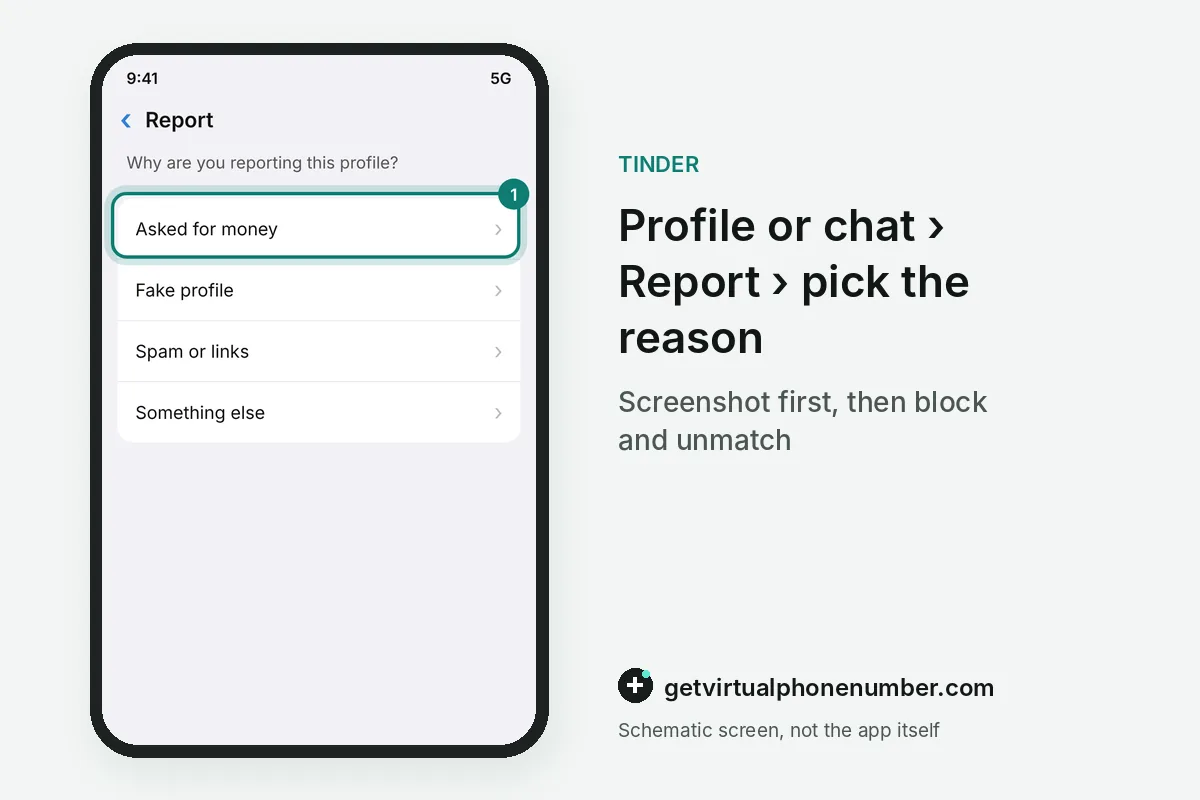
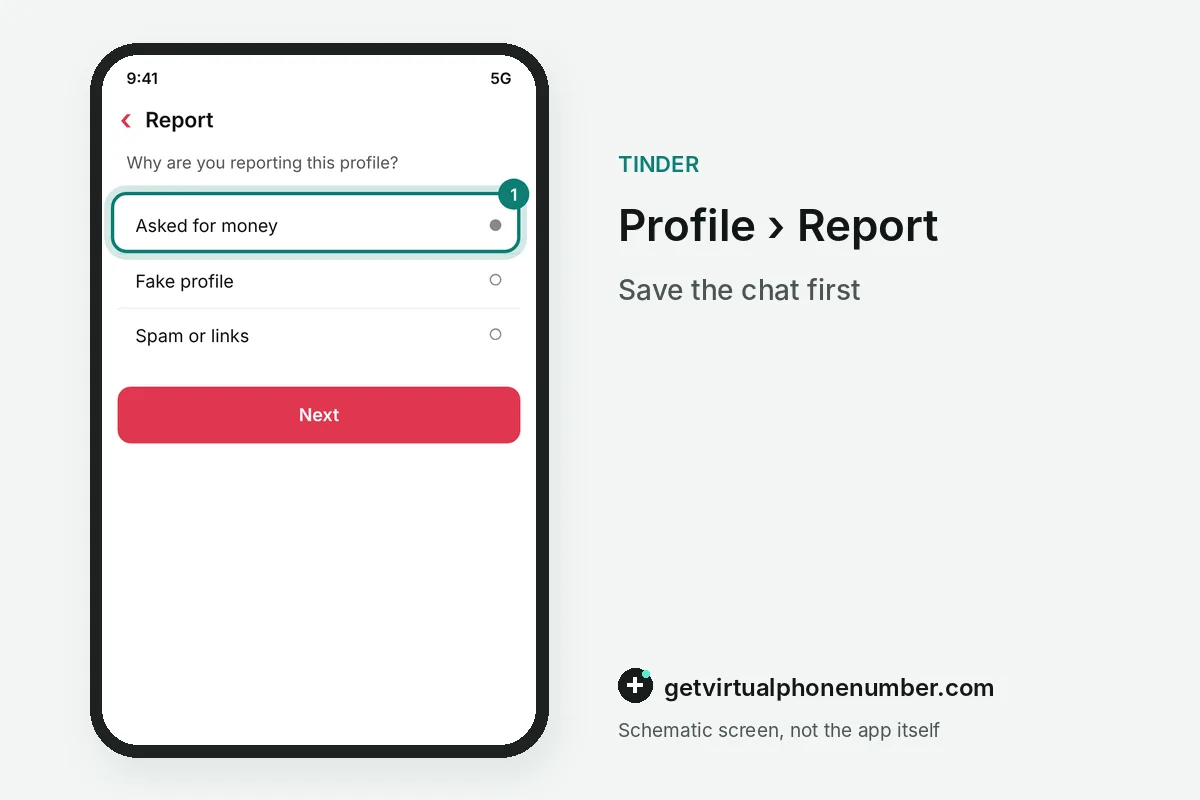
Report a Tinder scammer
- Save the evidenceTake screenshots of the Tinder profile, the chat and any payment request before you block.
- Open the report optionReport from the scammer's profile page or from the chat window.
- Pick the reasonChoose the option that fits, such as a request for money, a fake profile or spam.
- Block and unmatchBlock the account so the Tinder scammer cannot contact you again from that profile, then unmatch so the chat leaves your list.
- Secure your accountIf you shared a code, contact Tinder support and check your login details.
 Canada
 United States
 Netherlands
 Sweden
 Algeria
 Philippines
 Sri Lanka
 Slovenia
 United Kingdom